
When you build a product, sooner or later you run into this question:
Should UI text always be grammatically correct?
Or is it better to shorten copy, even if that means breaking "proper" English?
This isn't a theoretical debate. It shows up in real product decisions every day.
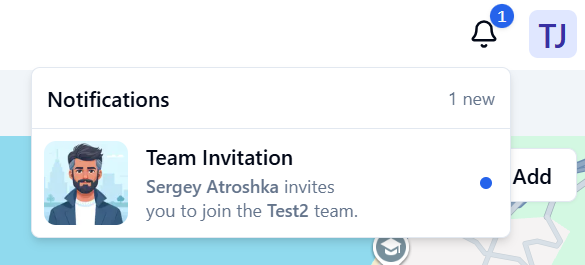
In Mapfolks, it surfaced with a simple notification:
"Sergey invited you to Test team."
Should it be:
"the Test team"?
Short answer: yes — in this case, absolutely.
Long answer: let's talk about how we approach UI copy in Mapfolks, and why.
UI Copy Is Not Formal English (and That's OK)
First, an important clarification.
UI copy is not the same as written prose.
It lives under very different constraints:
- limited space
- fast scanning instead of reading
- repetition
- international users
- mobile screens
Because of that, perfect grammatical correctness is not the primary goal.
Clarity, speed, and tone matter more.
That's why you see patterns like:
- "Invite sent"
- "Location updated"
- "Added to team"
- "Join team"
These are not full sentences — and that's fine.
This isn't laziness.
It's a UI dialect that users intuitively understand.
But There Is a Line You Shouldn't Cross
While shortening text is often good UX, not all UI text is equal.
The moment your product:
- addresses a user directly
- mentions another person
- describes a social action
- sends a notification or invite
...it stops being "interface chrome" and starts being human communication.
And that is where grammar matters.
The Mapfolks Example (Why "the" Matters)
Let's look at the example again:
"Sergey invited you to Test team."
From a UX point of view, this line:
- names a real person
- describes a personal action
- represents the product speaking on someone's behalf
That means it should read the way a person would actually speak.
Grammatically correct version:
"Sergey invited you to the Test team."
Without "the", the sentence feels:
- system-generated
- slightly ESL (English as a Second Language)
- less polished
- less trustworthy
It's a small word — but small things compound.
Especially in a product like Mapfolks, where trust, privacy, and human relationships are central.
When Shortcuts Are OK (and Encouraged)
We intentionally relax grammar in places where:
- the text is structural
- the meaning is obvious
- speed matters more than tone
Examples that are perfectly fine:
- "Invite to team"
- "Join team"
- "Pending invites"
- "Team settings"
- "Invite sent"
These are labels or states, not messages from a person.
Users don't expect full sentences here.
When Grammar Must Be Correct
In Mapfolks, we treat these as non-negotiable:
- notifications
- invitations
- emails
- user-to-user actions
- anything that could be read aloud naturally
If the text sounds wrong when spoken, it's wrong in the UI.
The Mapfolks Copy Style Guide
This is the internal rule set we follow.
1. Labels and Buttons
- Short
- Fragment-style
- Articles optional
✅ "Invite to team"
✅ "Join team"
✅ "Team members"
✅ "Join team"
✅ "Team members"
2. Status Messages and Toasts
- Compact
- Neutral
- Grammar relaxed but clear
✅ "Invite sent"
✅ "Location updated"
✅ "Settings saved"
✅ "Location updated"
✅ "Settings saved"
3. Notifications and Invites
- Full sentences
- Grammatically correct
- Human tone
✅ "Sergey invited you to the Test team"
❌ "Sergey invited you to Test team"
❌ "Sergey invited you to Test team"
4. Emails
- Fully correct English
- Friendly but precise
- No UI shortcuts
Emails are not UI chrome — they represent the brand directly.
A Simple Rule of Thumb
We use this decision rule internally:
If the text could be spoken aloud by a person, it must be grammatically correct. If it's a UI label or state, grammar can be relaxed.
It's simple, but it scales surprisingly well.
Why This Matters for Mapfolks
Mapfolks is not a CRUD dashboard or an internal admin tool.
It's about:
- people
- location
- trust
- social context
- privacy
Language is part of the product experience.
Tiny grammatical slips don't just look sloppy — they subtly undermine confidence.
And confidence is everything when you're asking users to:
- share where they are
- invite others
- join teams
- trust a map with real human connections
Final Thoughts
Shortening UI text is good UX.
Breaking grammar blindly is not.
In Mapfolks, we don't aim for academic English —
we aim for clear, human, intentional language.
That's why:
- ❌ "Sergey invited you to Test team" is not acceptable
- ✅ "Sergey invited you to the Test team" is
It's a small detail — and small details are what make a product feel thoughtful instead of rushed.